If you’re shopping for an under sink RO system, or planning to stock one for your customers, you’ll run into this question pretty fast. Tankless or tank?
Both designs use the same core idea. Water gets pushed through a reverse osmosis membrane that holds back most dissolved solids. The real difference is what happens after that. One stores purified water for later. The other makes it the moment you open the faucet.
This guide covers how each design works, where each one wins, and how to pick the right one for a home, a store shelf or a small business. We’ll also use real models from our own factory so you can see what the specs look like in practice.
How a Tank RO System Works
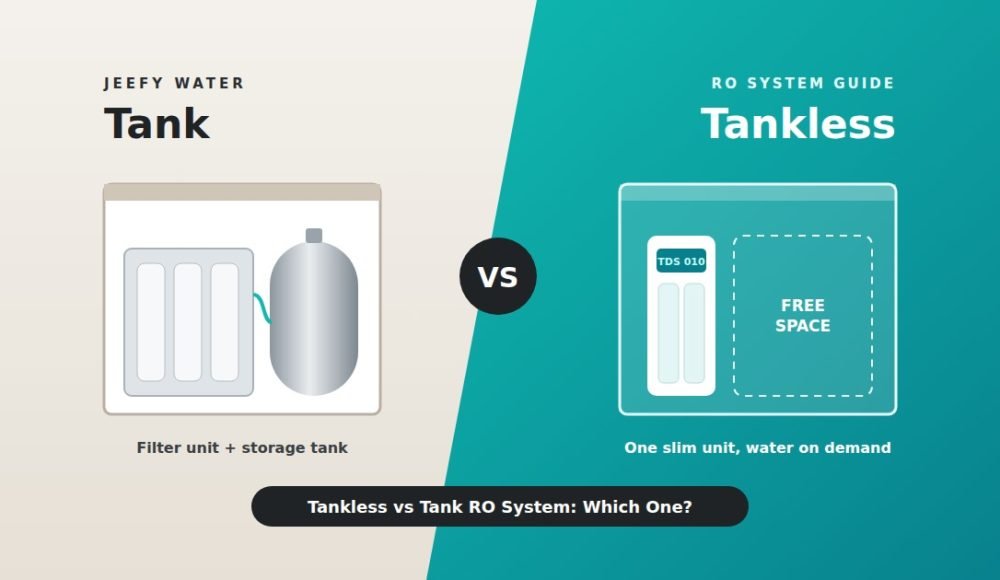
A traditional RO system makes water slowly and stores it in a pressurized tank, which usually sits next to the filter unit under the sink. When you open the faucet, air pressure inside the tank pushes the stored water out. Once the level drops, the system starts refilling it.
This setup made a lot of sense when membranes were small. A 50 or 75 GPD membrane can’t keep up with a running tap, so the tank works as a buffer. You get a glass of water right away, even though the membrane needed hours to make it.
The trade-offs are easy to spot once you live with one:
- The tank takes up a big chunk of cabinet space.
- Water sits in the tank between uses, sometimes overnight.
- Flow is strong at first and gets weaker as the tank empties.
- The tank needs occasional cleaning and, at some point, replacing.
How a Tankless RO System Works
A tankless reverse osmosis system, often called a direct flow RO system, skips storage completely. It uses a booster pump and a high-capacity membrane to purify water on demand. You open the tap, the pump starts, and water runs through the filters straight to your glass.
This only works because membranes got much bigger. A tankless unit has to keep pace with you in real time, so it needs a rating of several hundred gallons per day. If you’re not sure what those numbers mean, our guide on what GPD means in RO systems breaks it down.
To give you a real example, our JF-M90 is a tankless unit available in 600G, 800G, 1000G and 1200G versions, with purified water flow from 1.5 to 3.0 L/min depending on the model. No tank is needed at any of those sizes.
Tankless vs Tank RO: Side by Side
| Factor | Tank RO system | Tankless RO system |
| Under-sink space | Filter unit plus a separate tank | One compact unit |
| Water freshness | Stored water waits in the tank | Made fresh every time you open the tap |
| Flow at the tap | Strong at first, drops as the tank empties | Steady, based on the membrane rating |
| Power | Basic models can run on water line pressure alone | Needs power for the pump and controls |
| Smart features | Usually basic or none | TDS display, filter reminders and auto flush are common |
| Upfront cost | Usually lower | Usually higher |
| Best fit | Tight budgets, no outlet near the sink | Modern kitchens, small cabinets, easy upkeep |
Where Tankless RO Systems Win
- They save a lot of space. Without a tank, the whole system fits in one slim box. Our JF-M80 is just 116 mm wide and sits in a footprint 30% smaller than the M3 it was built on. The M3 and M90 both keep a slim 140 mm profile. In a crowded kitchen cabinet, that difference is huge.
- Every glass is fresh. Water isn’t sitting around waiting for you. It’s purified right when you need it, which is a big selling point for families who care about taste.
- You can match the flow to the user. Tankless models come in a range of sizes. The JF-M80 is offered in 200G, 600G and 800G versions with 0.5 to 2.0 L/min of flow. The M90 goes up to 1200G. A small apartment and a busy family kitchen don’t need the same machine, and tankless lines make that easy to plan.
- Maintenance is much easier. Most modern tankless units are built around easy filter changes. On our M series, the push-n-pull design lets you swap a cartridge in about 3 seconds, with no tools and no plumber. An integrated waterboard replaces most of the loose tubing, which cuts down on connection points and leak risk. Filter life reminders tell users when it’s time for a new cartridge, and automatic flushing helps keep the RO membrane clean.
- Users can see their water quality. Many tankless units include a TDS display. The JF-M90 shows real-time TDS on its touch panel, and the JF-2018 shows raw water TDS and purified water TDS side by side. That kind of feedback builds trust with end users.
When a Tank RO System Still Makes Sense
Tankless isn’t the right answer for every job. A tank design can still be the better pick when:
- There’s no power outlet under the sink, or the power supply isn’t stable. A basic tank system can work on line pressure alone.
- Budget is the top priority. Entry-level tank units usually cost less upfront.
- Demand comes in short, heavy bursts. In some commercial setups, a stored reserve helps the system deliver a lot of water at once.
That last point is why storage still shows up in commercial equipment. Our B1 commercial RO system, for example, has a pressure tank built inside its stainless steel body. It keeps water flow steady while the unit stays neat and compact, and it can be customized from 800 to 1600 GPD. Our B2 takes a different route and uses a constant-pressure water supply system to keep flow uninterrupted.
How to Choose Between Tankless and Tank RO
Run through these questions before you buy or place an order:
- How much space is under the sink? Measure the cabinet width first. Slim tankless units are made for tight spaces.
- How many people will use it, and how fast? A couple filling a few glasses a day needs less flow than an office pantry. Larger homes and small offices usually lean toward the higher GPD ratings.
- Is there an outlet nearby? Tankless units need power. If there’s none, a tank system may be simpler.
- Who will change the filters? If it’s the end user, tool-free cartridges and replacement reminders matter a lot.
- Do users want to see water quality? If yes, look for a TDS display.
- What does your market expect? If you’re a distributor or brand owner, think about what your buyers are asking for now, not five years ago.
What This Means for Distributors and Brand Owners
Every residential RO model in Jeefy’s current lineup, including the M90, M80, M3, 2016 and 2018, is a direct flow design. Models like the M3 and M80 are built with our own proprietary molds, so the tankless format is where most of our design work goes.
If you want to build your own tankless RO line, we can help at three levels. Basic customization covers color, logo, configuration, packaging and carton design. Upgraded customization adds specialized cartridges such as mineralizing, alkaline, ORP/hydrogen-rich and UV sterilization. For brands that want something fully unique, we support tailor-made molds and exterior designs.
Jeefy started as a family business in 2008 and has been building water purification systems at our Xiuwu Donghai factory ever since, supplying partners in more than 80 countries.
FAQ
Is a tankless RO system better than a tank RO system?
For most new kitchens, yes. Tankless units save space, deliver fresh water on demand and are easier to maintain. A tank system still makes sense when there’s no power near the sink or when the lowest upfront price matters most.
Does a tankless RO system need electricity?
Yes. It uses a pump to push water through the membrane on demand, and it powers features like the display, filter reminders and automatic flushing.
Can I convert a tank RO system into a tankless one?
Not really. Tankless systems rely on a different pump and a much larger membrane. In most cases, replacing the unit is the practical option.
What GPD rating do I need for a tankless RO system?
It depends on how many people use it and how quickly they draw water. Our GPD sizing guide walks through 400G, 800G and 1200G options.
Do tank RO systems still have a place in commercial use?
Yes. Some commercial units use built-in storage or constant-pressure supply to keep flow steady during busy periods.
Planning a tankless RO range or comparing options for your market? Contact our team or email info@jeefywater.com and tell us what you need.