Think about how often you heat water in a normal day. Tea in the morning. Coffee after lunch. A bowl of instant noodles. A baby bottle in the middle of the night. In a lot of homes, the kettle works harder than any other appliance in the kitchen.
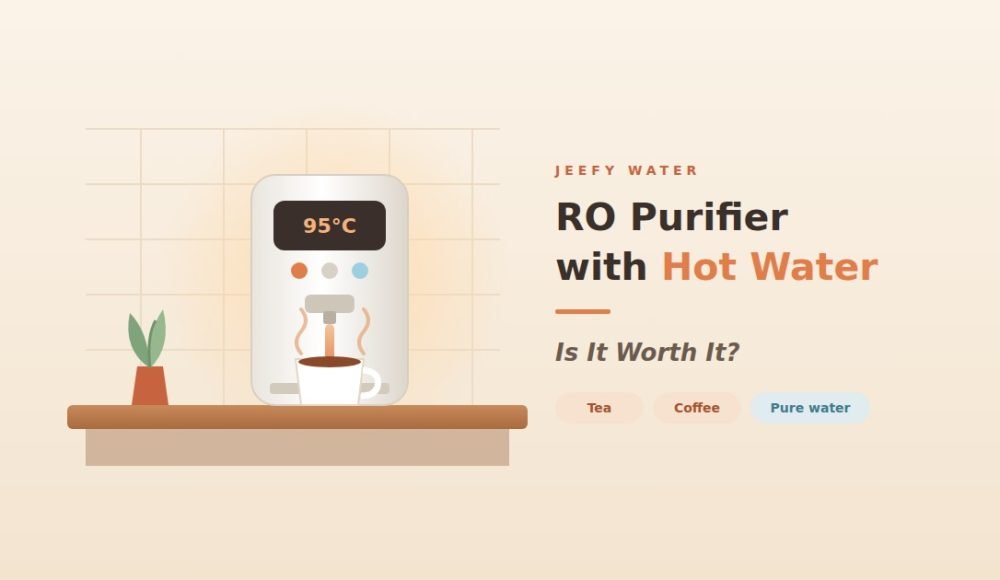
An RO water purifier with hot water puts both jobs into one machine. It purifies the water first, then heats it to the temperature you choose. No filling a kettle, no waiting around, and one less appliance on the counter.
That sounds great, but it isn’t the right fit for every home. We’ve built heating RO purifiers at our factory for years, including our H1, which has sold more than 200,000 units around the world. In this guide, we’ll explain how these systems work, the different types, the real pros and cons, and what to check before you buy one or add one to your product range.
Quick answer: An RO water purifier with hot water is worth it if you heat water several times a day and want purified water in every hot drink. It saves steps and counter space. If you rarely use hot water, or you need large volumes for a busy business, a standard RO system or a commercial unit is usually a better choice.
What Is an RO Water Purifier with Hot Water?
It’s a reverse osmosis purifier with a built-in heating function. Water runs through the normal RO filter stages first, so what gets heated has already been purified. Then you pick a temperature and dispense it.
Some models only heat. Others heat and cool, giving you hot, room temperature and cold water from one unit. Some come with a kettle you can lift off and carry to the table.
Most heating RO purifiers sit on the counter instead of under the sink. That’s because you need easy access to the display, the temperature controls and the outlet.
How a Heating RO Purifier Works
The process happens in two parts.
Part 1: Purification. Tap water goes through sediment and carbon filters to remove particles, chlorine and odors. Then it’s pushed through the RO membrane, which removes dissolved solids, heavy metals, bacteria and viruses. If you want the details on each step, our guide to RO filter stages walks through them one by one.
Part 2: Heating (and sometimes cooling). The purified water then goes to a heating section. Depending on the design, it’s either heated as you dispense it or warmed in a small built-in container or kettle. Models with cooling send water through a separate cooling section for cold drinks.
Because the water is purified before it’s heated, you’re never boiling unfiltered tap water.
RO Hot Water vs Boiled Tap Water
A lot of people boil tap water and assume that makes it “clean.” Boiling does kill germs. But it doesn’t remove dissolved minerals, metals or chemicals. As some of the water evaporates, those dissolved solids stay behind in what’s left.
That’s also why kettles slowly build up white scale. The minerals in hard water stick to the heating surface over time.
An RO purifier with heating works differently. The membrane removes most of the dissolved solids before the water ever gets hot. So you get purified hot water, and there’s much less mineral content left to form scale inside the heater.
| Boiled tap water | Heated RO water | |
| Kills germs | Yes | Yes, and the RO membrane also removes bacteria and viruses |
| Removes dissolved solids | No | Yes, most of them are removed by the membrane |
| Removes chlorine taste | Partly | Yes, through the carbon stages |
| Scale buildup in the heater | Common with hard water | Much lower, since most minerals are removed first |
| Steps involved | Fill, boil, wait, pour | Select temperature, dispense |
Benefits of an RO Water Purifier with Hot Water
1. Purified water in every hot drink
Tea and coffee are almost all water, so the water you start with shows up in the cup. Starting with purified water means no chlorine taste and no dissolved solids from the tap.
2. Less waiting and fewer steps
You skip the fill, boil and wait routine. Choose the temperature, press the button and you’re done. It doesn’t sound like much, but it adds up fast when you heat water five or six times a day.
3. The right temperature for each job
Not everything needs boiling water. Different teas, coffee, baby formula and cooking all call for different heat levels. Models with multi-level heating let you pick the right setting instead of boiling everything and waiting for it to cool.
4. One machine instead of two
A water purifier and a kettle take up two spots on the counter. A heating RO purifier takes up one. In a small kitchen or apartment, that space is valuable.
5. Hot and cold from one unit
Models that also cool give you everything from one machine. That’s handy in hot climates, small offices and homes where people want cold water without filling bottles for the fridge.
6. Less limescale to clean
Because most of the minerals are removed before heating, there’s far less material available to form scale. That means less descaling compared with boiling hard tap water in a regular kettle.
Downsides to Know Before You Buy
A heating RO purifier isn’t perfect for everyone. Here’s what to weigh:
- Higher upfront price. You’re buying a purifier and a heater in one, so it usually costs more than a basic RO system.
- It needs power. Heating and cooling both use electricity. Look at how the model heats water and whether it keeps water warm all day.
- Counter space. Most units sit on the counter, so you need a spot near a power outlet and a water line.
- Filters still need changing. Heating doesn’t replace normal maintenance. Pre-filters and the RO membrane still need replacing on schedule.
- Not built for heavy volume. A household heating unit isn’t designed for a busy café or a large office.
- Hot water safety. Any appliance that dispenses hot water needs care around children.
Types of RO Water Purifiers with Hot Water
Type 1: Purification, heating and cooling in one unit
These all-in-one machines purify, heat and cool. They suit homes that want hot and cold water from one place.
Our H1 is built this way. It combines water purification, heating and digital cooling with a digital display. It’s designed for areas with heating needs at an affordable cost, and it’s one of our most popular models, with more than 200,000 units sold globally.
Type 2: Multi-level heating with an external kettle
Some models focus on hot water and give you more control over it. Our WJ offers multi-level heating with an expansive display that makes temperature selection easy. It also comes with an external kettle, so you can carry hot water to the table instead of standing at the machine. It’s a strong fit for homes with high hot water demand.
Type 3: Under-sink RO plus a separate hot water dispenser
This setup keeps the purifier hidden under the sink and adds a separate hot water unit. It can work well, but it means two products, two installations and two sets of maintenance.
| Type | Best for | Main advantage | Main trade-off |
| Heating + cooling all-in-one | Homes wanting hot and cold from one unit | Everything in one machine | Takes counter space |
| Multi-level heating with external kettle | Heavy tea and hot drink users | Fine temperature control and a portable kettle | Focused on hot water |
| Under-sink RO + separate heater | Kitchens that want the purifier hidden | Clean counter look | Two products to install and maintain |
Who Should Buy an RO Purifier with Hot Water?
It makes the most sense for:
- Tea and coffee drinkers who heat water many times a day.
- Families with babies who need warm water ready at any hour.
- Homes in regions where drinking warm or hot water is part of daily life.
- Small offices and break rooms that want purified hot water without a separate kettle.
- Small apartments where counter space is tight.
It’s probably not the best choice if you mostly drink cold water and only boil a kettle now and then. In that case, a standard under-sink RO is simpler and cheaper. Our tankless vs tank RO guide can help you choose one.
It’s also not built for heavy commercial use. If you’re serving dozens of drinks an hour, look at a commercial system like our JF-M80P, which is rated at 1500G with a purified water flow of 3.75 L/min. Our commercial RO buying guide explains how to size one.
Using a Hot Water RO Purifier for Baby Formula
This is one of the most common reasons parents look at heating purifiers, so it’s worth getting right.
The World Health Organization’s guidelines on preparing powdered infant formula recommend using water that has been boiled and allowed to cool to no less than 70°C. They also say the water should be left for no more than 30 minutes after boiling to stay at that temperature.
So if baby formula is one of your main reasons for buying, check that the purifier has a temperature setting that reaches at least 70°C. Always follow the instructions on your formula and your pediatrician’s advice too.
What to Check Before You Buy
- Heating options. One fixed temperature or several levels? Multi-level heating is more useful if you make different kinds of drinks.
- Maximum temperature. If you’ll use it for tea or formula, make sure it gets hot enough.
- Cooling. Decide whether you want cold water from the same machine. If yes, choose a model that heats and cools.
- Filtration stages. The heating is only half the product. Check that the purification side has solid sediment, carbon and RO stages.
- Display and controls. A clear display makes it easy to pick the right temperature, especially when several people use it.
- Safety features. Look for things like a child lock on the hot water outlet.
- Size and placement. Measure your counter first. Our H1 measures 560 x 290 x 440 mm and our WJ measures 550 x 190 x 430 mm.
- Filter access and reminders. Check how easy it is to reach and replace the cartridges.
- Energy use. Find out whether the unit heats on demand or keeps water hot all the time.
- Parts and support. Make sure replacement filters will be easy to get for years, not just months.
Maintenance Tips for Hot Water RO Purifiers
- Replace pre-filters on time. Sediment and carbon pre-filters are usually replaced every 6 to 12 months. They protect the membrane, which is the most expensive filter in the system.
- Watch the membrane. RO membranes commonly last 1 to 3 years. If your purified water TDS rises above 10 to 15% of your tap water TDS, it’s time to plan a replacement.
- Keep the outside and drip area clean. Wipe the outlet and drip tray regularly.
- Clean the kettle if your model has one. Even with purified water, a quick rinse keeps it fresh.
- Follow the reminders. If your unit has filter life alerts, use them instead of guessing.
Safety Tips for Homes with Kids
- Use the child lock on the hot water outlet if your model has one.
- Place the unit where small children can’t reach the dispensing area.
- Teach older kids which button is hot water.
- Let very hot water cool before giving it to children.
Heating RO Purifier vs Standard RO + Kettle
| Factor | Standard RO + kettle | RO purifier with hot water |
| Appliances needed | Two | One |
| Steps for a hot drink | Fill, boil, wait, pour | Select temperature, dispense |
| Temperature control | Usually boil only, unless the kettle has settings | Many models offer multiple heat levels |
| Cold water | Room temperature unless you chill it | Available on models with cooling |
| Where it sits | Purifier under the sink, kettle on the counter | On the counter |
| Upfront cost | Usually lower | Usually higher |
For Distributors and Brands: Building a Hot Water RO Line
Hot water RO purifiers sit out on the counter, so they’re part of the kitchen’s look. That makes design more important than it is for a hidden under-sink unit. It’s one reason the H1 and WJ both come with glass front panels that can be customized to match your brand.
Beyond the panel, we support OEM and ODM orders at three levels. Basic customization covers color, logo, configuration, packaging and carton design. Upgraded customization adds specialty cartridges such as mineralizing, alkaline, ORP/hydrogen-rich and UV sterilization. Full mold design gives you tailor-made molds and a unique exterior.
We work with clients directly, factory to client, and our self-developed molds give us full control over cost and quality. Our Donghai New Energy manufacturing hub covers 20,000 m², with 100+ skilled professionals, advanced assembly lines and strict testing. Jeefy started as a family business in 2008 and now supplies partners in more than 80 countries.
FAQ
Can an RO water purifier give hot water?
Yes. Some RO purifiers have a built-in heater. Water is purified first, then heated to the temperature you choose.
Is heated RO water better than boiled tap water?
Boiling kills germs but doesn’t remove dissolved solids. RO removes most dissolved solids before the water is heated, so you get purified hot water and less scale in the heater.
Do hot water RO purifiers also give cold water?
Some do. Our H1 combines purification, heating and digital cooling. Others, like our WJ, focus on multi-level heating.
Can I use an RO hot water purifier for baby formula?
You can, if it reaches the right temperature. WHO guidelines recommend preparing powdered formula with water at no less than 70°C. Check the model’s settings and follow your formula’s instructions.
Where should I install an RO purifier with heating?
Most sit on the kitchen counter near a power outlet and a water line. Measure the space and leave room around the unit before ordering.
Does a hot water RO purifier use a lot of electricity?
It uses more than a standard RO system because it heats water. How much depends on the model and whether it heats on demand or keeps water hot all day.
How often do I need to change the filters?
The same as a regular RO system. Pre-filters are usually changed every 6 to 12 months, and RO membranes commonly last 1 to 3 years depending on water quality and use.
Will a hot water RO purifier get limescale?
Much less than a kettle using hard tap water, since the RO membrane removes most of the minerals before heating.
Is a hot water RO purifier good for offices?
For small offices and break rooms, yes. For large offices with heavy demand, a commercial RO system is usually a better fit.
Can I customize a hot water RO purifier for my brand?
Yes. On our H1 and WJ, the glass panel can be customized, and we also offer logo, color, packaging, filter and full mold options for OEM and ODM orders.
Final Thoughts
An RO water purifier with hot water is a simple upgrade that removes a daily chore. You get purified water in every cup, the right temperature for each drink and one less appliance on the counter. It makes the most sense for homes and small offices that use hot water often.
Want to add a hot water RO purifier to your range, or need help choosing the right model for your market? Contact our team or email info@jeefywater.com and tell us what your customers need.