If you sell RO water purifiers, you know where the hidden costs are. It’s not always the unit price. It’s the customer calling about a leak, the technician visit for a filter change the customer couldn’t figure out, or the return of a unit that “stopped working” because the membrane was never flushed.
A low maintenance RO system stops a lot of those problems before they start. Most of it comes down to design choices made at the factory, long before the product reaches your warehouse.
As an RO water purifier manufacturer, we build these choices into our products to keep service calls down for our distribution partners. This guide covers eight design features worth asking for, with real examples from our lineup and a question to put to any manufacturer you’re considering.
Why a Low Maintenance RO System Matters to Distributors
For an end user, an easy-care purifier is a nice bonus. For a distributor or brand, it’s a business decision:
- Fewer service calls mean lower support costs
- Fewer leaks and faults mean fewer returns and warranty claims
- Easy filter changes keep customers buying replacement cartridges instead of giving up on the unit
- A product that just works earns better reviews and more referrals
So when you compare RO systems, look past flow rate and stage count. Ask how the product will behave after six months in a real kitchen.
1. Tool-Free Filter Replacement
Filter changes are the most common maintenance job on any RO system. When they’re hard, customers either call for help or skip them. Neither is good for you.
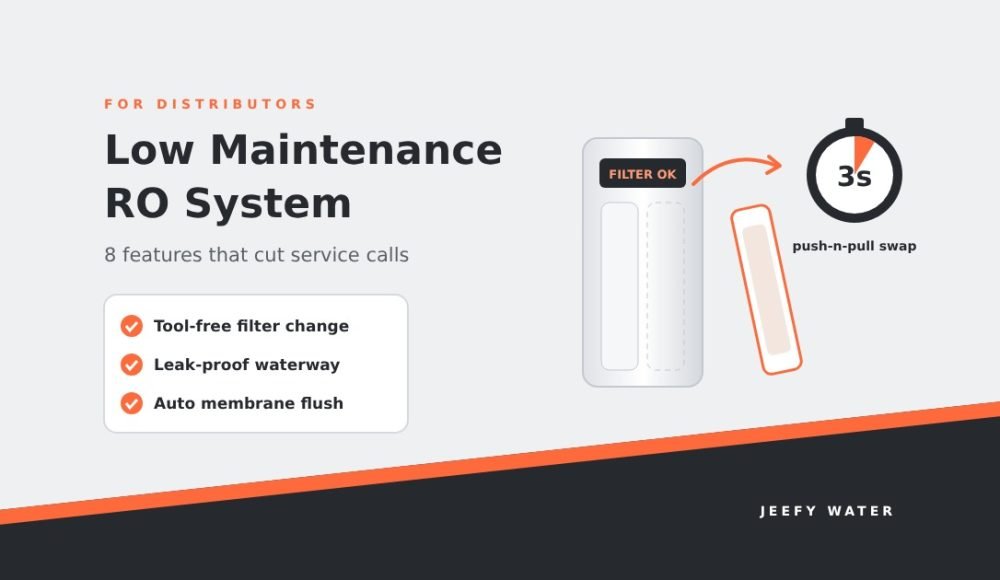
Our M-series uses a push-n-pull filter system that makes it simple:
- Push the filter handle and the cartridge pops out
- Pull the old cartridge out
- Insert the new cartridge and lock it in place
It takes about 3 seconds and needs no tools and no plumber. Our commercial JF-M80P uses the same idea with a horizontal pull filter.
Ask your manufacturer
Can an end user change every filter without tools, and how long does it take?
2. An Integrated Waterboard Instead of Loose Tubing
Traditional RO systems link each part with tubes and fittings. Every connection is a possible leak point, and a leak under the sink is one of the most stressful problems a customer can have.
Our M-series and M80-P use a high-pressure integrated waterboard. It’s a one-piece structure that removes those pipe connections and reduces leakage risk to near zero. It’s made from food-grade materials, and with fewer parts, assembly and repairs are faster.
We explain this in more detail in why integrated manifolds are transforming modern RO systems.
Ask your manufacturer
How many tube connections are inside the unit, and is the waterway one piece?
3. Automatic Membrane Flushing
The RO membrane is the most expensive part of the system. Over time, impurities build up on its surface. Regular flushing clears them away and helps the membrane last longer.
The catch is that most users will never flush a membrane on their own, so the system should handle it. Our JF-M90, JF-M3 and JF-2016 all have automatic flushing. On the M90, users can also start a flush with a touch key, and on the JF-M80 and M3 a short press of the button starts a flush cycle.
Ask your manufacturer
Does the system flush the membrane on its own, or does the user have to remember?
4. Filter Life Reminders
Customers rarely remember when they last changed a filter. A reminder tells them when it’s time.
This matters for two reasons. Clogged pre-filters starve the membrane and shorten its life, which leads to complaints about slow flow or poor water. And timely reminders mean steady replacement cartridge sales for you.
Every model in this guide has filter reminders. On the M90, M80 and M3, LED indicators track each cartridge separately. The JF-2018 tracks all four filter stages (PP, C1, RO, C2). A long press resets the counter after a change.
Ask your manufacturer
Does the reminder track each cartridge, or is it one timer for the whole system?
5. A Clear Status Display
When something seems off, the customer’s first question is usually whether the purifier is working at all. A clear display answers that before they pick up the phone.
Our M90, M80-P, 2016 and 2018 show working modes such as Purify, Flush, Full, Lack and Check. Customers can see what’s happening, and they can tell your support team exactly what the screen shows.
Ask your manufacturer
Does the display show status modes your support team can work with?
6. TDS Monitoring
A TDS display shows how much dissolved material is in the water. For users, it’s proof the purifier works. For you, it’s an early warning.
As an RO membrane wears, it lets more dissolved solids through and TDS starts to climb. Our rule of thumb: when purified water TDS rises above 10 to 15% of the tap water TDS, it’s time to plan a new membrane.
The M90 and 2016 show real-time TDS. The 2018 shows tap water and purified water TDS side by side, which makes membrane checks easy. The M80-P adds adjustable TDS for commercial users.
Ask your manufacturer
Does the unit show TDS, and can it show both tap and purified readings?
7. Cartridge Build Quality
A cartridge that leaks at the seams or won’t seat properly creates exactly the kind of call you want to avoid. Build quality here matters more than most buyers expect.
On our JF-M3, each filter cartridge is made with our own molds, injection-molded on its own and ultrasonically welded. That gives us tight control over quality from one batch to the next.
Ask your manufacturer
Are the cartridges molded in-house, and how are the housings sealed?
8. Known Core Components and Solid Materials
The parts inside decide how long the unit lasts. Our JF-2016 and JF-2018 use an E-chen pump, a Vontron membrane and a 304 food-grade faucet. On all the models in this guide, casings are ABS with no recycled materials, and most have a rubber bottom to cut noise.
Membrane quality matters a lot. In our RO membrane guide, we warn that heavily discounted “brand name” membranes sold through unofficial channels are often fake and perform poorly. A cheap membrane can turn into an expensive support problem.
Ask your manufacturer
Which pump and membrane brands do you use, and what is the casing made of?
Low Maintenance Features Across Our RO Lineup
| Feature | M80 | M90 | M3 | 2016 | 2018 | M80-P |
|---|---|---|---|---|---|---|
| 3-second tool-free filter change | Yes | Yes | Yes | Not listed | Not listed | Yes |
| Integrated waterboard | Yes | Yes | Yes | Not listed | Not listed | Yes |
| Membrane flushing | On button press | Automatic | Automatic | Automatic | Not listed | Not listed |
| Filter life reminder | Yes | Yes | Yes | Yes | Yes, all 4 stages | Yes |
| Status display | Not listed | Yes | Not listed | Yes | Yes | Yes |
| TDS display | Not listed | Real-time | Not listed | Real-time | Dual | Real-time and adjustable |
“Not listed” means the feature isn’t on that product’s page. Ask our team about configuration options for any model.
The Factory Matters as Much as the Design
Good design only helps if every unit is built the same way. A few things on the factory side make a big difference to service calls:
- Batch testing catches problems before they ship. Every production batch at our factory goes through incoming material inspection, in-process checks and final performance testing.
- Stable product design means the parts you stock today still fit the units you sold last year. We focus on long-term cooperation and stable designs rather than short-term, low-price changes.
- Parts availability keeps your customers running. After-sales parts availability is part of how we support long-term partners.
- In-house production of molds, injection molding, assembly and testing gives us direct control over quality.
If you’re still comparing factories, our guide on how to choose an RO system manufacturer in China covers what to check.
Low Maintenance RO System Checklist
- Filters can be changed in seconds without tools
- The waterway is one piece, not a bundle of tubes
- The membrane is flushed automatically or with one button
- Each cartridge has its own life reminder
- The display shows clear working status
- TDS is visible, ideally for both tap and purified water
- Cartridges are molded and sealed with care
- The pump, membrane and faucet come from known sources
- The factory tests every batch before shipping
- Replacement parts will be available for the long term
FAQ
What makes an RO system low maintenance
Tool-free filter changes, fewer pipe connections, automatic membrane flushing, filter reminders and clear status and TDS displays. Together they cut user mistakes and leaks.
What is an integrated waterboard
It’s a one-piece structure that replaces the tubes and fittings inside the unit. With fewer connections, leak risk drops to near zero and repairs are simpler.
Why does automatic flushing matter
Flushing clears impurities from the RO membrane and helps it last longer. Most users won’t do it themselves, so automatic flushing protects the membrane for them.
How often should RO filters be changed
Sediment and carbon pre-filters are usually replaced every 6 to 12 months. RO membranes commonly last 1 to 3 years, depending on water quality and use.
How do I know when an RO membrane needs replacing
Watch the TDS. When purified water TDS rises above 10 to 15% of tap water TDS, or flow drops noticeably, plan a replacement.
Do low maintenance features cost more
They can add to the unit price, but they often save more through fewer service calls, returns and warranty claims.
Which Jeefy model is easiest to maintain
Our M-series combines push-n-pull filters, an integrated waterboard and filter reminders. The M90 adds a smart panel with real-time TDS and a full status display.
Can I customize these features for my brand
Yes. We offer basic customization (color, logo, configuration and packaging), upgraded cartridges and full mold design. Talk to our team about what your market needs.
Sell an RO System That Doesn’t Come Back
The best RO system for a distributor is one customers install, use and forget about, until it’s time to buy new filters. A low maintenance RO system makes that possible.
Want to compare models or plan a custom RO line? Contact our team, email info@jeefywater.com or call +86 130 8371 6106.