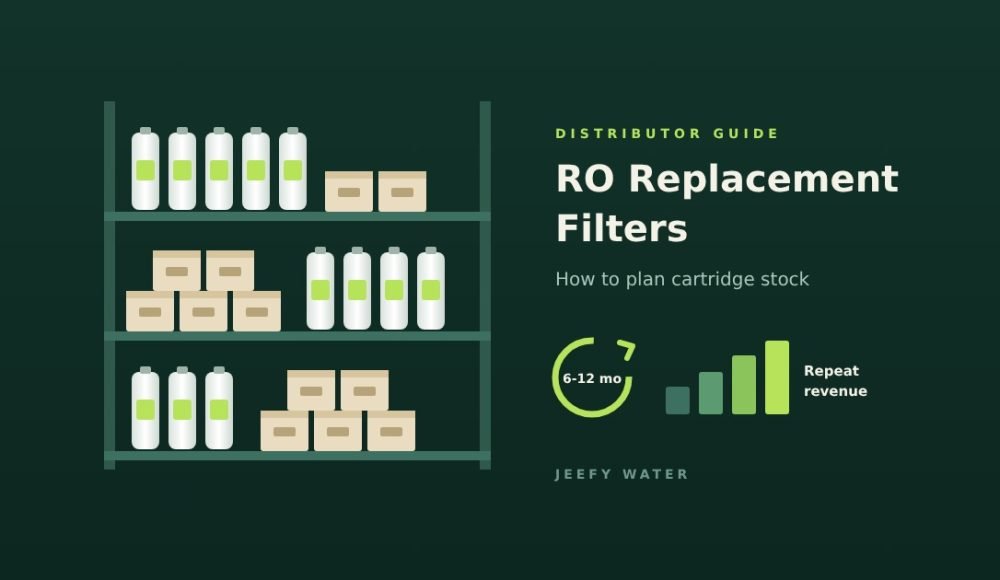
Selling an RO water purifier is a one-time sale. Selling RO replacement filters is a relationship that lasts as long as the unit does. For many distributors, cartridges turn into one of the steadiest income streams in the business.
That only works with a plan. Run out of cartridges and customers buy cheap alternatives somewhere else, or stop changing filters and blame the purifier when the water gets worse. Overstock and your cash sits in boxes on a shelf.
We’re an RO water purifier manufacturer in China, and many of our partners sell both systems and filters. This guide shows how to map the cartridges in each model, follow a realistic RO filter replacement schedule, forecast demand from your installed base and keep customers coming back to you.
Why RO Replacement Filters Matter for Your Business
Every RO system has filters that wear out. Sediment and carbon pre-filters catch particles and chlorine. The RO membrane removes dissolved solids. Sooner or later, all of them need replacing.
For a distributor, that opens up three things:
- Recurring revenue from every unit you’ve ever sold
- Regular contact with customers, which leads to upgrades and referrals
- Better product performance, because units with fresh filters work better and generate fewer complaints
That last point gets missed a lot. A purifier with clogged filters gives slow flow and worse water. The customer rarely blames the filter. They blame the product, and often the brand that sold it.
Step 1: Map the Cartridges in Each Model
Start by listing the cartridges in every model you sell. Here’s how it looks for our main RO lineup:
| Model | Cartridges | Cartridges per unit |
|---|---|---|
| JF-M80 | PCB (PP + CB) composite, RO membrane | 2 |
| JF-M90 | PCB (PP + CB) composite, RO membrane | 2 |
| JF-M3 | PCB (PP + CB) composite, RO membrane, CB post-carbon | 3 |
| JF-2016 | PP, UDF carbon, RO membrane, T33 post-carbon, optional alkaline | 4 or 5 |
| JF-2018 | PP, UDF carbon, RO membrane, T33 post-carbon, optional alkaline | 4 or 5 |
| JF-M80P | 2 PCB composite, 2 RO membranes (800G each) | 4 |
Look at the gap between composite and separate cartridge designs. The M80 and M90 need only two cartridges, because one PCB filter handles both sediment and carbon. The 2016 and 2018 use a separate cartridge for each job. Fewer cartridge types are easier to stock, while separate cartridges let each stage be replaced on its own timeline. Our RO filter stages guide explains the trade-offs.
Step 2: Follow a Realistic RO Filter Replacement Schedule
Each cartridge wears out at its own pace. These are the general ranges we work with:
| Cartridge | Typical replacement | Signs it’s due |
|---|---|---|
| Sediment (PP), carbon (UDF or CB) and PCB composite pre-filters | Every 6 to 12 months | Slower flow, chlorine taste coming back, filter reminder |
| RO membrane | Commonly every 1 to 3 years | Purified TDS above 10 to 15% of tap TDS, or reduced flow |
| Post-carbon (CB or T33) and add-ons like alkaline | Follow the unit’s filter reminder | Flat taste, filter reminder |
Where your customers land in these ranges depends on local water. Hard water, high TDS, old pipes and heavy use push replacements toward the short end. Good city water and light use stretch them out. Our RO membrane guide covers membrane life in more depth.
Step 3: Forecast Demand from Your Installed Base
Once you know the cartridges and intervals, the math is simple. For each cartridge type:
Yearly demand
Units in the field x replacements per unit per year
Here’s an example for 1,000 JF-M90 units in the field:
| Cartridge | Interval | Replacements per unit per year | Yearly demand for 1,000 units |
|---|---|---|---|
| PCB composite | 6 to 12 months | 1 to 2 | 1,000 to 2,000 |
| RO membrane | 1 to 3 years | About 0.33 to 1 | About 333 to 1,000 |
And for 1,000 JF-2018 units:
| Cartridge | Interval | Replacements per unit per year | Yearly demand for 1,000 units |
|---|---|---|---|
| PP sediment | 6 to 12 months | 1 to 2 | 1,000 to 2,000 |
| UDF carbon | 6 to 12 months | 1 to 2 | 1,000 to 2,000 |
| RO membrane | 1 to 3 years | About 0.33 to 1 | About 333 to 1,000 |
| T33 post-carbon | Per filter reminder | Based on the reminder setting | Confirm with our team |
The ranges are wide, so tighten them with your own data. Track what customers actually buy in the first year, factor in local water and adjust. Most distributors find their real number settles somewhere in the middle.
Step 4: Plan for Growth and Timing
Your installed base grows every month, and filter demand grows with it. Keep these in mind:
- New units sold this year won’t need their first pre-filter change for 6 to 12 months
- Membrane demand lags even further, since the first replacement comes after 1 to 3 years
- Busy sales seasons create filter waves later, so a strong season this year means a busy filter season next year
- Shipping time needs to be built into your reorder point
- Holiday periods like Chinese New Year can slow production and shipping across the industry, so order ahead of them
Step 5: Set a Safety Stock
Running out of filters costs more than one lost sale. It sends customers looking elsewhere, and some never come back.
A simple rule is to hold enough stock to cover expected demand for the full time it takes to reorder and receive new cartridges, plus a buffer for surprises. Fast movers like pre-filters need the biggest buffer. Membranes move slower, but running out means a customer with a purifier that doesn’t work, so keep those covered too.
How to Keep Customers Buying Filters from You
Use the filter reminders
Every model in the tables above has a filter life reminder. When it lights up, you want your customer to think of you first. Put your contact details or a reorder link on the unit, the box or a sticker near the filters.
Make filter changes easy
When filter changes feel hard, customers put them off or call a technician. Our M-series push-n-pull design lets users swap a cartridge in about 3 seconds, with no tools and no plumber. Easy changes mean more customers do them on time.
Offer filter bundles or plans
Selling a year’s worth of filters at once, or running a reminder service, keeps customers with you and smooths out your demand.
Use TDS to start the membrane conversation
Models with TDS displays, like the M90, 2016 and 2018, show customers when water quality changes. The 2018’s dual display shows tap and purified TDS side by side. When the purified number climbs, it’s a natural moment to suggest a new membrane.
Stick with stable designs
Few things frustrate a distributor more than a product change that makes old cartridges obsolete. We focus on long-term cooperation and stable product design, so the parts you stock keep fitting the units you’ve already sold.
Composite vs Separate Cartridges: What It Means for Your Stock
| Composite design (M80, M90, M3) | Separate cartridges (2016, 2018) | |
|---|---|---|
| Cartridge types to stock | Fewer | More |
| Ease for end users | Very simple, 3-second push-n-pull | More parts to keep track of |
| Flexibility | Sediment and carbon replaced together | Each stage replaced on its own schedule |
| Upsell options | Specialty cartridges through customization | Optional alkaline filter built into the design |
Neither is better in every case. Composite designs are easier to manage. Separate cartridges give customers more control and suit markets used to multi-stage systems.
Why Work with the Original Manufacturer
- Proper fit, since the cartridges are designed for the exact housing and waterboard in each model
- Consistent quality, since every production batch at our factory goes through incoming material inspection, in-process checks and final performance testing
- In-house production of molds, injection molding and assembly, with M3 cartridges injection-molded on their own and ultrasonically welded
- Long-term parts availability, so you’re not left wondering whether replacement components will still be there months down the line
- Genuine membranes, since heavily discounted “brand name” membranes from unofficial channels are often fake and perform poorly
Jeefy started as a family business in 2008 and now supplies partners in more than 80 countries. For brands that want to stand out, we also offer mineralizing, alkaline, ORP/hydrogen-rich and UV sterilization cartridges as upgraded customization. If you’re still comparing suppliers, see our list of the top water purifier manufacturers in China.
FAQ
How often do RO replacement filters need changing
Sediment, carbon and composite pre-filters are usually replaced every 6 to 12 months. RO membranes commonly last 1 to 3 years. Local water and daily use move these numbers.
How do I work out how many filters to stock
Multiply the units in the field by the replacements each cartridge needs per year, then add safety stock to cover your reorder time.
Which RO model is easiest for filter stocking
Composite designs like the M80 and M90 use just two cartridges, a PCB filter and an RO membrane, which keeps the number of cartridge types low.
Can I get replacement cartridges from Jeefy
After-sales parts availability is part of how we support long-term partners. Contact our team with your models and volumes and we’ll talk through replacement parts for your lineup.
Why avoid cheap aftermarket membranes
Heavily discounted membranes from unofficial channels are often fake and reject fewer dissolved solids. That leads to poor water and customer complaints.
How do I know when a customer needs a new membrane
Check TDS. When purified water TDS rises above 10 to 15% of tap water TDS, or flow drops, plan a replacement.
Can I sell specialty filters as an upgrade
Yes. We offer mineralizing, alkaline, ORP/hydrogen-rich and UV sterilization cartridges, and the 2016 and 2018 have an optional alkaline stage.
Will replacement filters fit the units I’ve already sold
We focus on stable product designs and long-term parts availability, so your stock keeps fitting the units in the field.
Turn Every Sale into a Repeat Customer
RO replacement filters are where a single sale becomes a long-term customer. Map your cartridges, plan your stock from day one, make reordering easy and source parts you can trust.
Want to talk about RO systems and replacement parts for your lineup? Contact our team, email info@jeefywater.com or call +86 130 8371 6106.