Shopping for a water purifier? You have probably seen 400G, 800G or 1200G printed on the box. That number is the GPD rating, and understanding GPD in RO systems keeps you from buying a unit that’s too slow for your kitchen or far bigger than you need.
GPD stands for gallons per day. It tells you how much purified water the membrane can make in 24 hours of nonstop running. So a 400G unit is rated for 400 gallons a day, or roughly 1,500 liters. No household drinks that much, which is exactly where the confusion starts.
What GPD in RO Systems Actually Measures
GPD is a lab figure, not a promise about your tap. Membrane makers test under fixed conditions, usually water at 25°C (77°F), about 60 psi of pressure and feed water in the few hundred ppm TDS range. Change any of those and the output moves.
Temperature matters most. A common rule of thumb says output falls by around 3% for every degree Celsius below 25°C, so winter tap water at 10°C can cut real production by a third or more. Low line pressure and high-TDS water pull the number down further.
So why do buyers care about a rating they’ll never fully reach? Because on a modern tankless reverse osmosis water purifier, GPD decides how fast water leaves the faucet. Older units filled a storage tank slowly overnight, and 50 or 75 GPD was plenty. Tankless designs purify on demand, so the membrane has to keep pace with you in real time. A higher rating means a quicker glass of water and less waiting to fill a pot.
Turning GPD Into Numbers You Can Picture
Gallons per day is an awkward unit when you’re standing at the sink. Liters per minute makes more sense:
| Rating | Rated output (liters/day) | Rated flow (liters/min) | Time to fill a 1 L bottle |
|---|---|---|---|
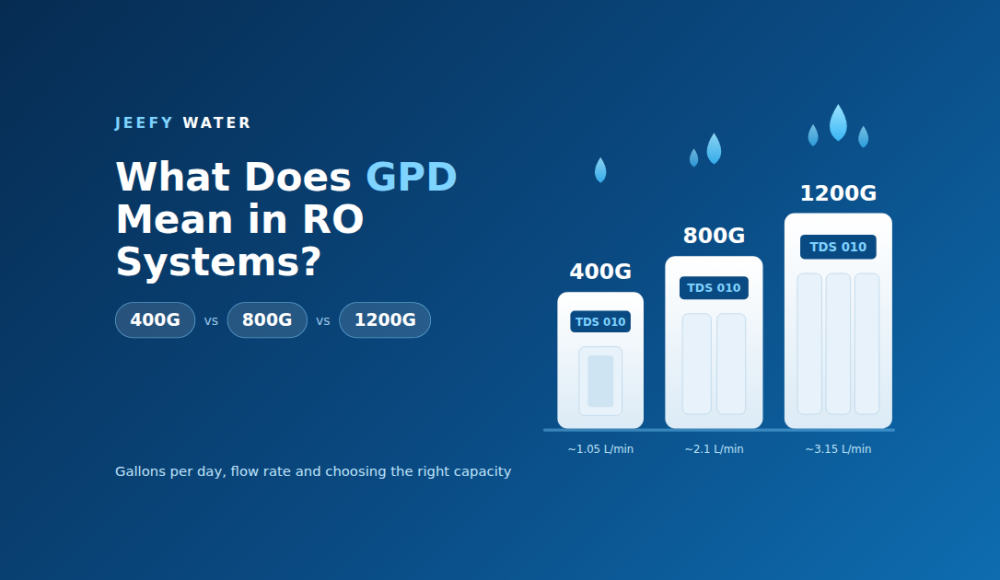
| 400G | about 1,514 | about 1.05 | about 57 seconds |
| 800G | about 3,028 | about 2.1 | about 29 seconds |
| 1200G | about 4,542 | about 3.15 | about 19 seconds |
These are best-case figures. In a real home, expect slower flow, especially in cold months.
400G vs 800G vs 1200G: Which Capacity Fits Your Needs?
The 400G RO System
A 400G RO system suits a couple or a small family of up to four people who mainly use purified water for drinking, tea and coffee, with some cooking now and then. Flow is steady rather than fast. It costs less to buy, fits easily under most sinks and usually has cheaper replacement parts. With decent water pressure and a small household, it does the job without fuss.
The 800G RO System
The 800G RO system is where most families end up, and for good reason. It pours about twice as fast as a 400G, so filling a large kettle or a cooking pot stops feeling like a chore. Homes with four to eight people, or anyone who cooks everything with purified water, will notice the difference daily. It also gives you headroom when winter slows the membrane down.
The 1200G RO System
A 1200G RO system is built for heavy use. Think big households, small offices, cafés, clinics and break rooms where people refill bottles all day. Flow is quick enough that nobody queues at the tap. These units often use a larger membrane or dual membranes plus a stronger booster pump, so they draw a bit more power and take up a little more room. For a two-person apartment it’s overkill. For a busy workplace it’s the right tool.
Other Things That Matter as Much as GPD
A big number on the box doesn’t make a great purifier by itself. Check the pure-to-drain ratio first. Every RO unit sends some water down the drain while it cleans, and newer tankless models waste far less than the old tank systems that dumped three or four liters for every liter they kept.
Look at the filter stages too. More stages don’t automatically mean better water, but a solid setup pairs sediment and carbon pre-filters with the RO membrane, often adding a post-carbon filter for taste. Component quality counts here. Trusted membranes like Vontron and pumps like E-Chen tend to hold their rating longer.
Space under the sink is easy to forget. Slim tankless units, some around 116 mm wide, fit cabinets where a tank system never would. Hard water deserves attention as well, since scale shortens membrane life. Pairing your purifier with a water softener protects the membrane and keeps real output closer to the rated GPD.
Choosing the Right Under Sink RO System
Start by counting people, then think about how they use water. One to three people who mostly drink it will be happy with 400G. Families of four to eight who cook with purified water should look at 800G. Offices, shops and homes with eight or more users belong in the 1200G range.
Stuck between two sizes? Go one size up. The extra flow costs little up front, and a faster under sink RO system is simply nicer to live with, particularly once cold weather slows everything down.
Our tankless lineup at Jeefy covers this whole spread. The JF-M80 and JF-2018 come in 200G to 800G options for homes. The JF-M90 and JF-M3 run from 600G to 1200G, and the JF-M80P reaches 1500G with dual RO membranes for commercial settings.
Buying RO Systems in Bulk? Work Directly With the Factory
For distributors, retailers and brand owners, GPD becomes part of product planning. Different markets favor different capacities. Buyers in regions with cold winters or weak water pressure often need a higher-rated membrane just to get normal flow, while budget retail lines lean on 400G models.
Sourcing from a water purifier manufacturer rather than a trading company makes this easier to get right. Jeefy has built RO systems in our own Henan factory since 2008 and ships to buyers in more than 80 countries. As an OEM/ODM water purifier partner, we can adjust GPD ratings, filter stages, housing design, faucet style and branding to match what your customers want, with flexible MOQs for new product lines.
Request a Quote for Custom RO Systems
Frequently Asked Questions
Is a higher GPD always better?
Not always. Paying for flow you’ll never use makes little sense, though some extra headroom does help in winter.
Does higher GPD lower water quality?
Not by itself. Purity depends mostly on membrane quality and system design, and a well-made high-flow membrane still removes the vast majority of dissolved solids.
Will an 800G unit really give me 800 gallons a day?
Only under test conditions with the system running nonstop for 24 hours. Your daily use will be a small fraction of that, and the rating mainly shows up as faucet speed.
How often should the RO membrane be replaced?
Usually every two to three years. Hard or high-TDS water can shorten that, while good pre-filtration stretches it out.
Still unsure which capacity suits your market or home? Tell us your water conditions and daily usage, and our team will recommend the right model.