A home RO purifier is built for a family. A commercial RO system is built for a lunch rush, a line at the coffee counter, or 50 people refilling bottles before a meeting. Put a household unit in those places and you’ll feel it fast: slow flow, filters that wear out early, and staff waiting at the tap.
This guide explains what to look for in a commercial reverse osmosis system, how to size it, and which design fits which kind of business. Whether you run a restaurant or you’re a distributor sourcing units for clients, the checklist below will save you from the most common buying mistakes.
What Makes a Commercial RO System Different
The filtration idea is the same as a home unit. Water passes through pre-filters and then a reverse osmosis membrane that holds back most dissolved solids. What changes is the scale and the build:
- Higher capacity. Commercial units are rated for far more water per day. Our commercial models, for example, run from 800 to 1600 GPD.
- Faster flow. They need to fill pitchers, kettles and machines without a long wait.
- More membranes. Some models run two RO membranes side by side to boost output.
- Tougher housings. Stainless steel bodies hold up better in busy kitchens.
- Built for long hours. They’re designed to run all day, not just a few times a day.
Who Needs a Commercial Reverse Osmosis System?
Restaurants and bars. Water goes into drinks, ice, soups, sauces and glassware. Clean, consistent water helps every one of those taste the same day after day.
Cafes and beverage shops. Coffee and tea are mostly water, so water quality shows up in every cup. Many coffee shops don’t want water that’s stripped of all minerals, since it can make coffee taste flat. That’s why adjustable TDS is a useful feature in this setting.
Offices and break rooms. A good office water purifier cuts down on bottled water deliveries and gives staff fresh drinking water on tap.
Dorms and shared buildings. Many people, many refills, often at the same times of day. Capacity matters most here.
7 Things to Check Before You Buy a Commercial RO System
1. Daily capacity and flow rate
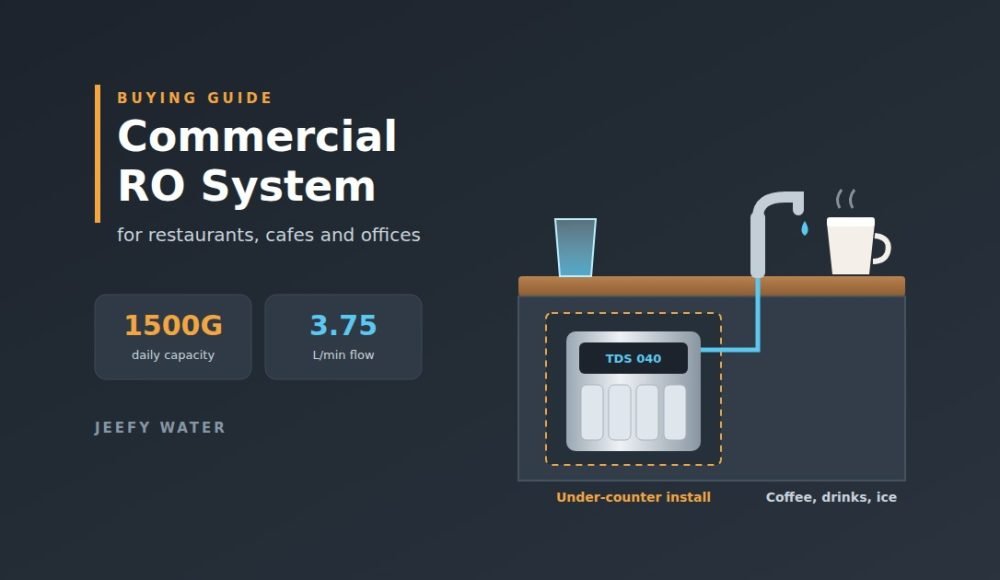
Start with two numbers. GPD (gallons per day) tells you how much purified water the system can make in 24 hours. Flow rate, usually shown in L/min, tells you how fast water comes out of the tap. For example, our JF-M80P is rated at 1500G with a purified water flow of 3.75 L/min. Keep in mind that GPD ratings are measured under test conditions. Real output depends on feed water temperature, pressure and TDS. Our GPD guide explains this in more detail.
2. Size for your busiest hour, not your average day
A cafe might use most of its water between 7 and 10 in the morning. If you size the system for the daily average, it will struggle when it matters most. Think about peak demand first, then pick the capacity.
3. Storage or direct flow
Some commercial units purify on demand. Others keep a reserve so they can deliver steady flow during busy periods. Our M80-P is a direct flow unit with no storage tank. The B1 has a pressure tank built right into its body, while the B2 uses a constant-pressure water supply system for uninterrupted flow. If you’re weighing these two approaches, our guide on tankless vs tank RO systems compares them side by side.
4. Build material
Busy kitchens are wet, warm and hard on equipment. Stainless steel housings resist corrosion and are easy to wipe down. Both the B1 and B2 are made entirely from stainless steel for that reason.
5. Footprint and installation space
Measure before you buy. An under-counter cube suits a bar or coffee counter. A taller freestanding unit suits a back kitchen or utility room. The M80-P measures 260 × 430 × 350 mm and is designed for under-counter installation. The X2 stands 1370 mm tall but is designed to blend in, so it can sit in a dining or service area without drawing attention.
6. Maintenance and downtime
Every minute spent changing filters is a minute your team isn’t serving customers. Look for:
- Tool-free filter changes. The M80-P uses a push-n-pull system that lets staff swap a cartridge in about 3 seconds.
- Filter life reminders, so nobody has to guess when cartridges are due.
- An integrated waterboard, which replaces loose tubing and cuts down on leak points.
- Clear status display. The M80-P shows Purify, Flush, Full, Lack and Check modes on its touchscreen.
7. TDS monitoring and control
A real-time TDS reading shows staff the system is doing its job. For beverage businesses, adjustable TDS goes a step further. The M80-P lets you set the final TDS level to suit specific recipes, beverages or local water conditions.
Jeefy Commercial RO Systems at a Glance
| Model | Capacity | Key features | Size (mm) | Good fit for |
| M80-P | 1500G, 3.75 L/min | 4 filters, 6 stages, dual 800G RO membranes, adjustable TDS, direct flow | 260 × 430 × 350 | Cafes, beverage counters, under-counter setups |
| X2 | 800 to 1600 GPD (customizable) | Sleek design that blends into the space | 550 × 370 × 1370 | Restaurants, bars, dorms |
| B1 | 800 to 1600 GPD (customizable) | Full stainless steel body, built-in pressure tank, easy to clean | 500 × 350 × 675 | Compact spaces that need durability and steady flow |
| B2 | Ask our team | Full stainless steel body, constant-pressure water supply | Ask our team | Sites that need uninterrupted flow |
You can see the full range in our Commercial Systems category.
Common Mistakes When Buying a Commercial Water Purifier
- Using a household unit in a business. It might work for a week. Then flow drops and filters wear out early.
- Sizing for the average day. Peak hours decide whether staff wait at the tap.
- Forgetting power and drainage. RO systems need a drain line, and pump-driven models need power. Check both before you pick a spot.
- Ignoring filter access. If the unit is jammed into a corner, filter changes get skipped.
- Skipping pre-filter changes. Pre-filters protect the membrane. Our RO membrane guide recommends replacing sediment and carbon pre-filters every 6 to 12 months, depending on the water.
Sourcing Commercial RO Systems as a Distributor or Brand
If you supply restaurants, cafes or offices, the product you choose becomes part of your reputation. Working directly with a factory gives you more control over specs, quality and cost.
At Jeefy, we work with clients directly, with no middle layer. Our self-developed molds and in-house production give us full control over cost and quality. Our manufacturing hub, Donghai New Energy, covers 20,000 m² and has a team of 100+ skilled professionals, advanced assembly lines and strict testing.
We offer OEM and ODM at three levels:
- Basic customization: color, logo, configuration, packaging and carton design.
- Upgraded customization: specialized cartridges such as mineralizing, alkaline, ORP/hydrogen-rich and UV sterilization.
- Full mold design: tailor-made molds and unique exterior designs.
Since starting as a family business in 2008, we’ve supplied water purification systems to partners in more than 80 countries.
FAQ
What is a commercial RO system?
It’s a reverse osmosis water purifier built for business use. Compared to a home unit, it offers higher daily capacity, faster flow and a tougher build for long hours of use.
What size RO system does a restaurant need?
It depends on how much water you use at your busiest time, not just per day. Our X2, which is designed for restaurants, bars and dorms, can be customized from 800 to 1600 GPD. Our team can help you size it based on your menu, seating and equipment.
Is RO water good for coffee?
RO water gives you a clean, consistent base. Many cafes prefer to keep some minerals for better flavor, which is why systems with adjustable TDS, like the M80-P, are a good fit for beverage use.
Can a commercial RO system protect kitchen equipment?
RO removes most of the dissolved minerals that cause scale. Feeding purified water to kettles, coffee machines and ice makers can help reduce scale buildup inside them.
How often should commercial RO filters be changed?
It depends on water quality and daily use. Follow the filter life reminder on your unit. As a general rule, sediment and carbon pre-filters are replaced every 6 to 12 months.
Ready to choose a commercial RO system for your business or your clients? Contact our team or email info@jeefywater.com with your daily water use and space details, and we’ll suggest the right setup.